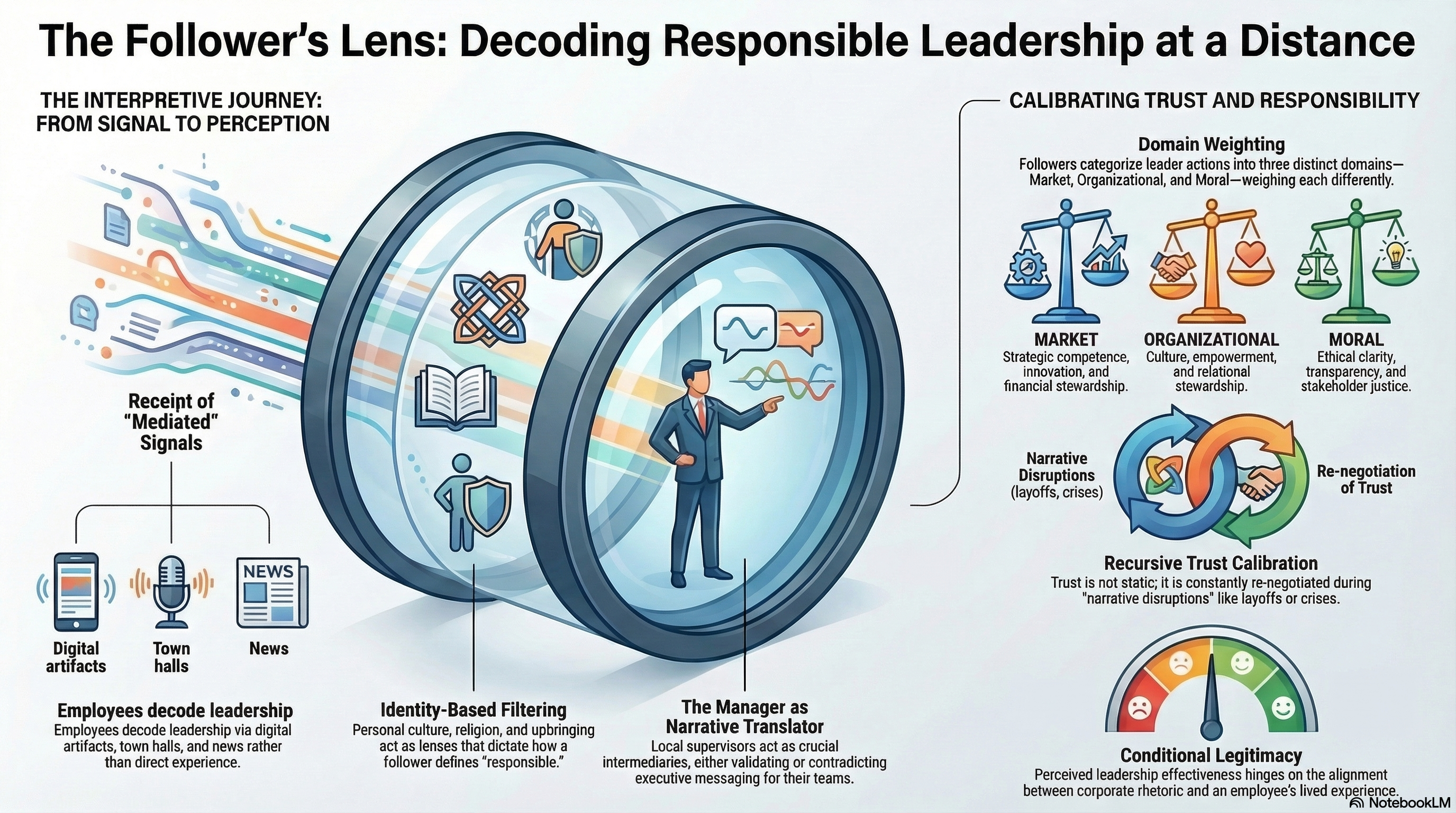
A narrative-inquiry dissertation on how entry-level employees — across extreme hierarchical distance — construct their own version of "responsible leadership." The leader doesn't hand it down. The follower builds it.
Responsible leadership isn't a trait a leader holds. It's a meaning a follower builds — indirectly, from a distance, and never finished.
Almost everything written about responsible leadership studies the leader's behavior. This study flips the lens to the people furthest from power: eight entry-level Microsoft employees who had never met Satya Nadella, yet held strong, detailed convictions about whether he led responsibly.
Their accounts were polyphonic — multiple, often contradicting versions of the same person coexisting at once: innovative strategist, cultural reformer, disciplined executive, and at times silent bystander. None was "the" truth. Each was constructed.
What separated them wasn't the facts. It was how each person weighted three domains of responsibility — and how a single disruption could quietly re-wire trust.
The study extends Lynham's Responsible Leadership for Performance (RL/P) framework by inserting the missing layer: how a follower actually processes a leader's signals into a verdict — under conditions of distance.
Every participant drew on the same six themes — but pulled hardest on a different domain of responsibility. The network maps each voice to the domain that anchored their verdict. Hover a name to trace its pull.
Edge weight = how heavily that voice leaned on the domain. Moral responsibility produced the widest disagreement.
Eight "restories" — the narrative-inquiry term for a participant's lived account, retold as a coherent arc from first impression to current trust.
Participants never named these categories — but every judgment fell into one of three. Divergence didn't come from the facts. It came from the weighting.
Strategic competence, innovation, financial stewardship — cloud, OpenAI, Copilot, acquisitions.
Culture, empowerment, internal solidarity — the gap between stated psychological safety and lived team experience.
Ethical clarity, transparency, principled risk — layoffs vs. care, and silence during geopolitical crisis.
Cross-case analysis of all eight narratives surfaced six recurring patterns — processual, not linear. Signals get mediated, filtered, weighted, disrupted, and recalibrated.
Strategic decisions, public communication, and organizational actions are the raw stimuli through which leadership is read.
Perception forms indirectly — through managerial translation, peer talk, media, and digital artifacts. Never direct contact.
Culture, faith, upbringing, and career stage become the lens. The same event reads as visionary, pragmatic, or reprehensible.
Followers implicitly sort leadership into market, organizational, and moral domains — and assign each a different weight.
Layoffs, a sudden AI pivot, silence in a crisis — inflection points that destabilize or harden the prior verdict.
Trust is provisional and recalibrated over time. Prior events shape how every future signal gets interpreted.
Five practical implications for anyone leading at scale — where most of your people will only ever know you through signals.
Every decision is decoded, not received. Assume the gap between what you intend and what gets heard is the real surface area of your leadership.
To a distant employee, the skip-level manager is the CEO. The local manager either amplifies or contradicts the message from the top.
Silence in a crisis is itself a signal. The moments you'd rather not address are exactly where trust gets re-rated.
Dominance in the market doesn't offset a perceived moral gap for everyone. Different people are grading you on different scales.
It's renegotiated after every disruption. Credibility is a running balance, not a one-time deposit.
A 12-minute listen, an 8-minute watch, two visual summaries, the full academic work, and a quick-reference brief.
That's the condition this research lives in — and most leadership at scale runs on it. If you want to pressure-test how your own narrative lands across distance, let's talk.
Weekly notes on the discipline, prediction markets, and the work of installing predictive planning inside real organizations. No fluff.